# Emojis in a Text: Why Only 70 Characters?
> A single emoji drops a text from 160 to 70 characters. Here's the GSM-7 → UCS-2 switch explained, what it costs, and alternatives that fit in one SMS.
- Source: https://www.envoyer-sms-gratuit.com/en/blog/2026-11-09/sms-emojis-caracteres-ucs2-gsm7
- Published: 2026-11-09 (9 November 2026)
- Author: L'équipe Envoyer SMS Gratuit
- Language: en
- Categories: Guide
- Tags: Format SMS, SMS gratuit, Rédaction, SMS en ligne, Envoyer un SMS, smartphone
---
**Short answer:** a standard SMS carries 160 characters because it uses the GSM-7 alphabet (7 bits per character). The moment a single character falls outside that alphabet — an emoji, but also a curly quotation mark ” ("), an em dash — (long dash) or an œ (oe ligature) — the entire message switches to UCS-2 encoding (16 bits per character) and its capacity drops to **70 characters**. One lone 🙂 can therefore turn your text message from 1 into 3 billed segments.
It's the classic nasty surprise of a first bulk send. You write a 150-character message, read it back, feel it lacks a little warmth, add a heart at the end — and the sending tool's counter suddenly reads "3 SMS". The text hasn't grown by a single word: its alphabet has changed.
This article explains the exact mechanism, lists the characters that trigger the switch (some of them invisible to the naked eye when you copy and paste from a word processor), and shows what to do when you really do want an emoji.
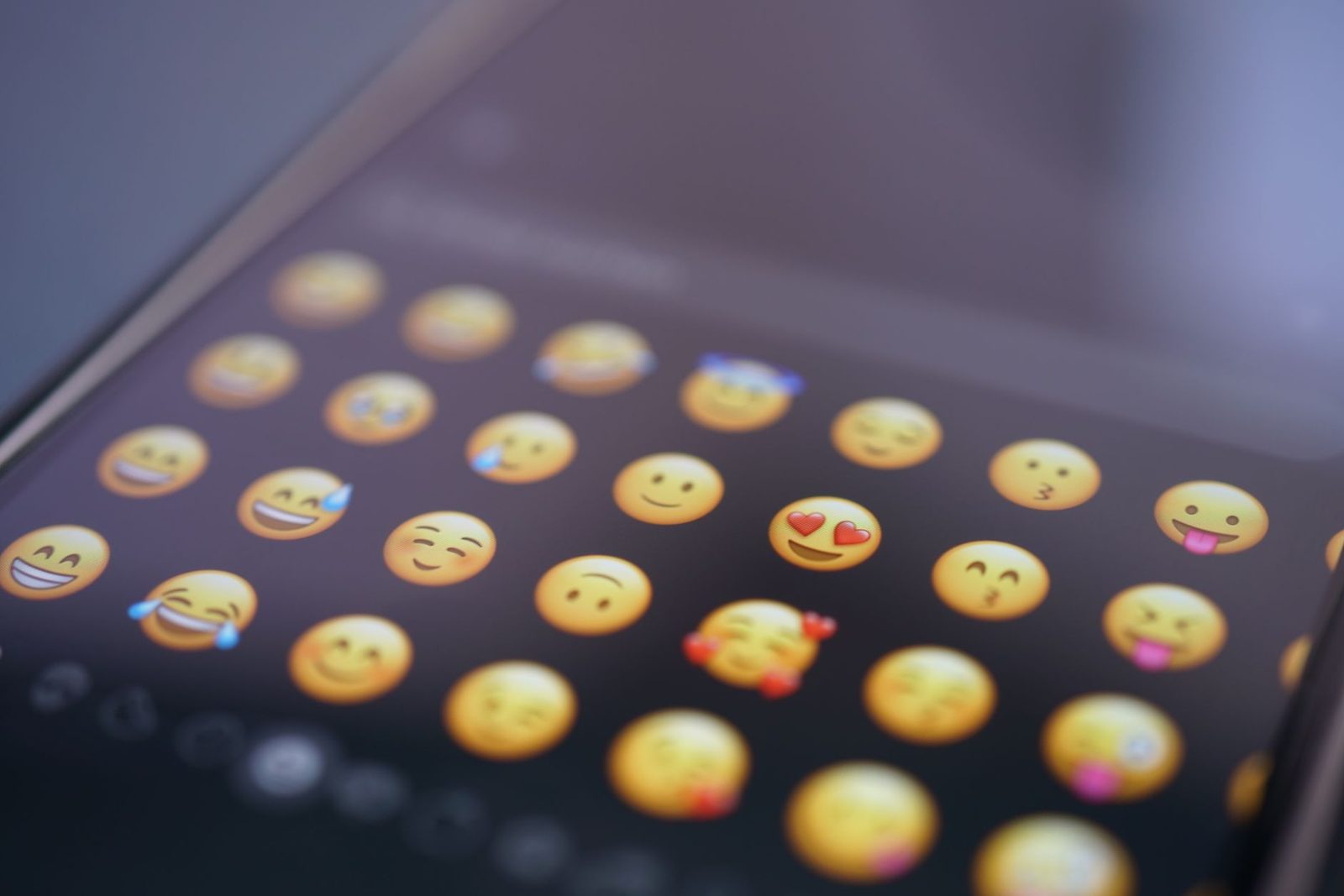
## Why is an SMS 160 characters and not 200?
Because the signalling channel an SMS travels on offers 140 usable bytes, and the alphabet chosen at the outset encodes each character in 7 bits: 140 × 8 / 7 = 160.
The format is described in the 3GPP specifications, notably standard **TS 23.038**, which defines the so-called "GSM 7-bit" alphabet. That alphabet contains unaccented Latin letters, digits, basic punctuation and a handful of national characters (`é`, `à`, `è`, `ù`, `ç`, `ö`, `ñ`, the `£` symbol, and so on). An extension makes it possible to add a few extra signs — `[`, `]`, `{`, `}`, `\`, `|`, `^`, `~` and above all **the euro sign `€`** — but each of these counts as **two** characters, because it is written with an escape character.
When the text contains a character absent from that alphabet and its extension, the phone has no choice: it encodes the whole message in UCS-2, the 16-bit variant of Unicode. Each character then weighs 2 bytes, and 140 / 2 gives **70 characters** per segment.
| Encoding | Weight of one character | Capacity of a single SMS | Capacity per concatenated segment | |
| :--- | :--- | :--- | :--- | :--- |
| GSM-7 | 7 bits | 160 | 153 | |
| GSM-7 + extension character (€, \{, \}, \ | , etc.) | 14 bits for that sign | 160 "units" | 153 "units" |
| UCS-2 (emoji, œ, curly quotation marks, etc.) | 16 bits | 70 | 67 | |
The right-hand column is the one people forget. Beyond a single segment, the phone splits the message and puts a small assembly header in each piece (the *User Data Header*), which eats up 6 bytes. Hence 153 characters per segment in GSM-7 and 67 in UCS-2. That's why a 160-character text isn't "160 + 160" but "153 + 153" as soon as it goes over.
## Does an emoji count as one character or two?
Often two, sometimes four or more. The most recent emojis are encoded outside Unicode's basic plane and require a pair of 16-bit values (a *surrogate pair*): they therefore use 4 bytes, i.e. **2 UCS-2 characters**.
A few concrete examples, worth checking with a counter before sending:
- 😀 (grinning face): outside the basic plane → 2 UCS-2 units.
- ☺ (white smiling face, a legacy character): within the basic plane → 1 unit.
- 👍🏽 (thumbs up with a skin-tone modifier): the modifier is a full additional character in its own right → 4 units.
- ❤️ (heart with a variation selector): the heart + the `VS16` selector → 2 units.
- A family emoji or a regional flag: an assembly of several code points linked by invisible joiners → up to 10 units or more.
In other words: a message of 60 characters of text plus three "composed" emojis can already exceed 70 units and go out as two segments. The site's character counter lets you watch the switch happen live before you send — it's the only reliable method, because a word processor's preview counts nothing at all.
To test how things render on different screens — a recent emoji shows up as an empty box on an old handset — keeping an older-generation **[basic mobile phone](https://www.amazon.co.uk/s?k=t%C3%A9l%C3%A9phone+mobile+basique+grosses+touches&tag=ds0608-21)** to hand remains the most telling test for anyone messaging an elderly customer base.
## Which characters switch an SMS to UCS-2 without you noticing?
The most frequent culprits aren't emojis but typographic signs inserted automatically by office software. They're barely visible on screen, yet they drop the message from 160 to 70.
The most common traps in an English text:
- **Curly quotation marks** `“ ”` and typographic apostrophes `’`. The straight apostrophe `'` is in GSM-7; the curly `’`, inserted by default by Word, LibreOffice and most spell-checkers, is not.
- **Long dashes**: the em dash `—` and the en dash `–`. Only the hyphen `-` is in GSM-7.
- **Single-character ellipses** `…`, instead of three dots `...`.
- **The `œ` ligature** (and `Œ`), everywhere in French: vœux (season's greetings), cœur (heart), sœur (sister). It's the number one trap in end-of-year messages.
- **Accented letters that aren't catered for**: `â`, `ê`, `î`, `ô`, `û`, `ë`, `ï`, `ü`, `á`, `í`. Only `é à è ù ì ò ç ö ñ ü` (and a few others) appear in the GSM alphabet.
- **The non-breaking space** and the thin space, invisible but very much present after a copy-paste.
- **Bullets** `•` and arrows `→`.
One habit is enough to eliminate 90% of cases: write the message in a plain-text editor — Notepad on Windows, TextEdit in plain-text mode on Mac — rather than in a word processor, then paste it into the sending tool. Autocorrect no longer turns the straight apostrophe into a curly one.
For professionals who type a lot of messages from a computer, a **[keyboard with a numeric keypad](https://www.amazon.co.uk/s?k=clavier+AZERTY+filaire+pav%C3%A9+num%C3%A9rique&tag=ds0608-21)** makes it easier to type the useful accented characters directly, without going through insertion shortcuts that bring "rich" typography back in.
> A French irony: the word vœux (season's greetings) costs 70 characters of capacity all by itself. Writing meilleurs voeux (best wishes) with two separate letters is typographically questionable, but it keeps the message on a single segment.
## Should you give up on emojis in a text message?
No, but you have to choose: either an emoji and a short message, or a long message with no emoji. The worst scenario is the medium-length message with an emoji, which pays for three segments to carry 150 characters.
Three strategies hold up, depending on the context:
1. **A personal, short message to a single recipient.** Add the emoji without a second thought. One extra segment changes nothing when the plan includes unlimited texts, which is the case with the vast majority of carrier offers.
2. **A message sent from a website, a gateway or an API, billed per unit.** Work in strict GSM-7 and aim for 153 characters per segment. An emoji there multiplies the bill by two or three depending on the length of the text.
3. **A formal business message** (appointment reminder, summons, invoice chase): the emoji adds nothing and muddies the tone. The writing rules for a reminder are set out in our guide to [appointment reminder texts](/blog/2026-10-14/sms-rappel-rendez-vous-modeles-regles).
If you want the visual effect without the cost, a few substitutes stay in GSM-7: `:)`, `;)`, `<3`, `!`, `*word*` for emphasis, or simply a line break to give the message some air. It isn't as expressive, but it doesn't double the length.
## How does an extra segment translate into cost?
Each segment is a billed SMS. A 160-character message with an emoji becomes three UCS-2 segments: for 500 recipients, that means 1,500 texts paid for instead of 500.
You can work out the ballpark figure without knowing the rates by heart: multiply the number of recipients by the number of segments, then by your gateway's unit price. Since the public prices of sending platforms vary a great deal and change often, it's better to check the provider's current rate card than to rely on a figure read somewhere. What the encoding changes, by contrast, is fixed and depends on no supplier: 160 → 70, or 153 → 67 per segment.
Three practical consequences:
- **Check the platform's counter, not the phone's.** Many mobile apps show a "remaining before the next segment" count without saying which encoding they're counting in.
- **Watch out for personalisation fields.** A 150-character template that inserts `{firstname}` can cross the limit for long first names. Always budget for the worst case in your file.
- **Watch out for the opt-out notice.** For a commercial send, the mandatory unsubscribe wording ("STOP" in France) uses up fifteen or so characters that must be allowed for from the drafting stage.
The rules for sending to multiple recipients, including this question of opt-out wording and permitted sending hours, are covered in our article on [bulk texting from a PC](/blog/2026-10-17/sms-groupe-envoyer-plusieurs-destinataires-pc).
## How can you check a message's encoding before sending it?
The simplest way is to use a counter that explicitly displays the detected encoding, and not just the number of signs. The site's [SMS character counter](/outils/compteur-caracteres-sms) shows the GSM-7 → UCS-2 switch and the number of segments.
The manual method, useful when you inherit a template written by someone else:
1. Paste the text into a plain-text editor.
2. Run a find-and-replace on the five risky signs: `’` → `'`, `“` and `”` → `"`, `—` and `–` → `-`, `…` → `...`, `œ` → `oe`.
3. Reread words carrying unusual accents (fêtes (festivities), août (August), prêt (ready), connaître (to know)): they can often be rephrased.
4. Count again. If the counter still says UCS-2, an invisible character is still in there: delete the spaces at the start and end of lines, which often hide a non-breaking space.
5. Send the message to yourself before the bulk send — the only test that checks the encoding, the rendering and the splitting all at once.
For anyone handling these sends from a desk all day, a **[desk phone stand](https://www.amazon.co.uk/s?k=support+t%C3%A9l%C3%A9phone+bureau+r%C3%A9glable&tag=ds0608-21)** saves picking the handset up again for every delivery test, and a **compact power bank** comes in handy when the test device is used solely to receive checks.
## What about MMS, RCS and messaging apps?
These limits apply to SMS only. An MMS, an RCS message or a message sent through an internet messaging app uses neither GSM-7 nor the 140-byte channel: length there is practically unlimited and emojis cost nothing in particular.
It's a useful distinction to keep in mind when comparing sending methods. A message written from Google Messages for web may go out as RCS between two compatible devices — with no 160-character constraint — or fall back to SMS if one of the two isn't compatible, at which point all the rules described here apply again. Same text, same interface, two behaviours.
A **[protective case with a stand](https://www.amazon.co.uk/s?k=coque+smartphone+avec+support&tag=ds0608-21)** and a **tempered glass screen protector** extend the life of the device used as a test handset or a work line, which often gets handled dozens of times a day.
## In summary
- 160 characters in GSM-7, **70 in UCS-2**, and 153 / 67 per segment as soon as the message is split.
- A single character outside the GSM alphabet switches **the whole** message, not just the word concerned.
- The most frequent culprits in French: `’`, `“ ”`, `—`, `…`, `œ`, circumflex accents and non-breaking spaces — well ahead of emojis.
- `€`, `{`, `}`, `[`, `]`, `\`, `|`, `^`, `~` stay in GSM-7 but count **double**.
- On an unlimited plan, the emoji is free. On a gateway billed per message, it can triple the bill.
To dig further into writing a short, effective message, see our pointers on [the 160-character limit](/blog/2025-11-15/sms-160-character-limit), and to send from a browser without installing anything, the starting point remains the [free SMS sending](/) page.
*Updated 9 November 2026. The capacities given (160 / 153 / 70 / 67) follow from the 3GPP TS 23.038 and TS 23.040 specifications and do not depend on the carrier; gateway rates, on the other hand, change and should be checked with the provider concerned.*
## Frequently asked questions
**Why is my SMS 70 characters instead of 160?**
Because it contains at least one character missing from the GSM-7 alphabet: an emoji, a curly apostrophe, a long dash, an `œ` or an unsupported accent. The entire message then moves to UCS-2, where each character weighs two bytes.
**Does an emoji count as one character?**
Rarely. Most modern emojis take up two UCS-2 units, and up to four or more with a skin-tone modifier or an assembly (flags, families).
**Does the euro sign `€` switch the message to UCS-2?**
No. The euro belongs to the GSM-7 alphabet's extension: it stays in GSM-7 but uses up two characters of the available capacity.
**How can you write vœux (season's greetings) without losing 90 characters?**
By writing voeux with two separate letters, or by rephrasing (mes meilleurs messages pour cette nouvelle année — my best wishes for the new year). The `œ` ligature doesn't exist in the GSM-7 alphabet.
**Do emojis cost more to send?**
On a mobile plan with unlimited texts, no. From a sending website, a gateway or an API billed per message, yes: the number of billed segments can double or triple.
{/* image-sources: https://images.pexels.com/photos/31995460/pexels-photo-31995460.jpeg?auto=compress&cs=tinysrgb&dpr=2&h=650&w=940 https://images.pexels.com/photos/31995461/pexels-photo-31995461.jpeg?auto=compress&cs=tinysrgb&dpr=2&h=650&w=940 */}